Narrative collection
NECx — a dialogical colligation engine in living workplaces
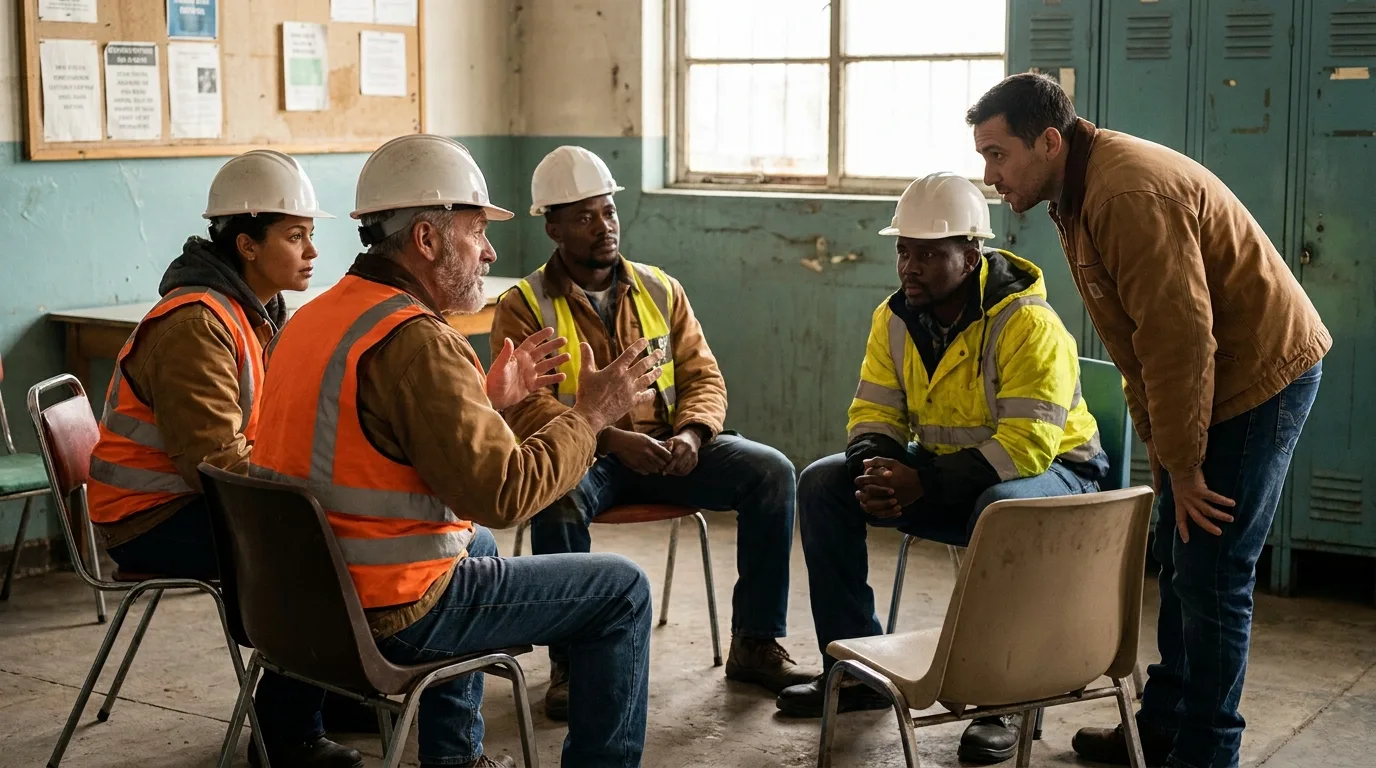
- Convene workers, vocational trainers and community representatives in a witnessed, dialogical 'circle' at energy-transition workplaces. The circle elicits narrativizing — the verb — rather than freezing a profile: it captures the operation a worker performs, in the register where sense is actually made.
- Colligation, not classification. Following Whewell's and Morgan's account, the circle binds (colligates) scattered evidence under the operation a taxonomy box cannot see — an allagmatic move (Simondon): recovering the operation behind the structure. Two classes of account: research narratives (work-life experience) and narratives of transitions (sectoral / ecological change).
- Map evidence on spatio-temporal and causal-relational grids using STS-informed diagramming for mechanism visualization. Three narrative scales — micro-narrative · story · saga cycle.
- Three instalments progressively remove the researcher: (1) researcher-led, (2) colleague-led circles, (3) researcher removed. With biases named in anthropological, feminist and decolonial studies, this triangulates the individuation of knowledge 'in vivo and in situ' — addressing the constitute-vs-contaminate question: when narrative is elicited in a social event rather than found in an archive, the apparatus becomes part of the narrativizing.
- Detect scripts and narrative performance — e.g. 'redundancy → retraining → green job' — showing how workers narrate policy transitions through lived experience. Affect (Jajdelska's narrative performativity) is treated as load-bearing, not ornamental.
- Map to the EU competence frameworks (ESCO · GreenComp · DigComp) as an output, never an input — the worker's own words kept as provenance at every step. Test narrative inference against qualitative rigour standards (internal consistency · coherence · adequacy to evidence) using Narrative Science epistemology.