GREENPULSE

Proposal submitted successfully · under evaluation

Contact

Lived · layers 03 and 04 · WP3 · WP4 · WP6 · WP7

What workers and communities mobilise

NECx — Sharing Circles and biographic interviews

The Narrative Evidence Collection (NECx) records the competences workers and communities actually use, in their own voices and across five registers.

Planned work, not a funded project

The lived layer

Sharing Circles and biographic interviews

03

Lived · What workers and communities mobilise

NECx — Sharing Circles and biographic interviews

Instrument
NECx: 54 Sharing Circles and 130–145 biographic interviews; three researcher-presence conditions
Produced in
WP3 Tasks 3.1–3.3; WP4 Task 4.1; framework and field manual from WP2 Tasks 2.2–2.3
Deliverables
D2.1, D2.2; D3.1; D4.1, D4.2, D4.6
Used next by
ESCOX tagging (Task 6.2); discordant-case register (Task 8.3); Expo-Action (Task 5.4)
Answers
RQ1, RQ7

The Narrative Evidence Collection (NECx) records the competences workers and communities actually use, in their own voices and across five registers: ontological, cognitive, technical, affective and behavioural (OCTAB). It is based on the IRES NCMx method developed and tested at Green Forum Sweden, and formalised for this project in D2.2. Its transposition to European industrial settings is not established; it is tested here.

Each of the 18 sites hosts one four-day site-week of three Circles on successive days, 5–8 participants each, followed by individual biographic interviews in the participant's language: 54 Circles, about 350 participants, ~130–145 interviews. Round 1 runs M8–M14 at 12 sites in six countries (36 Circles); Round 2 adds one site per country (M29–M36). Each guide separates individual accounts (Strand I) from the collective account of the site, trade or community (Strand C).

Across the three Circles of a site-week the researcher progressively withdraws, from researcher moderation to insider moderation with no researcher present, so the design measures what the researcher's presence does to what people say.

Coherence is not the acceptance criterion. An account can always be made coherent by discarding what resists it. Every narrative finding must pass a stated demarcation criterion, and cases that do not fit are logged and reported in a discordant-case register. A project reporting no discordant cases fails the criterion (KER8).
The protocol

Narrative Evidence Collection

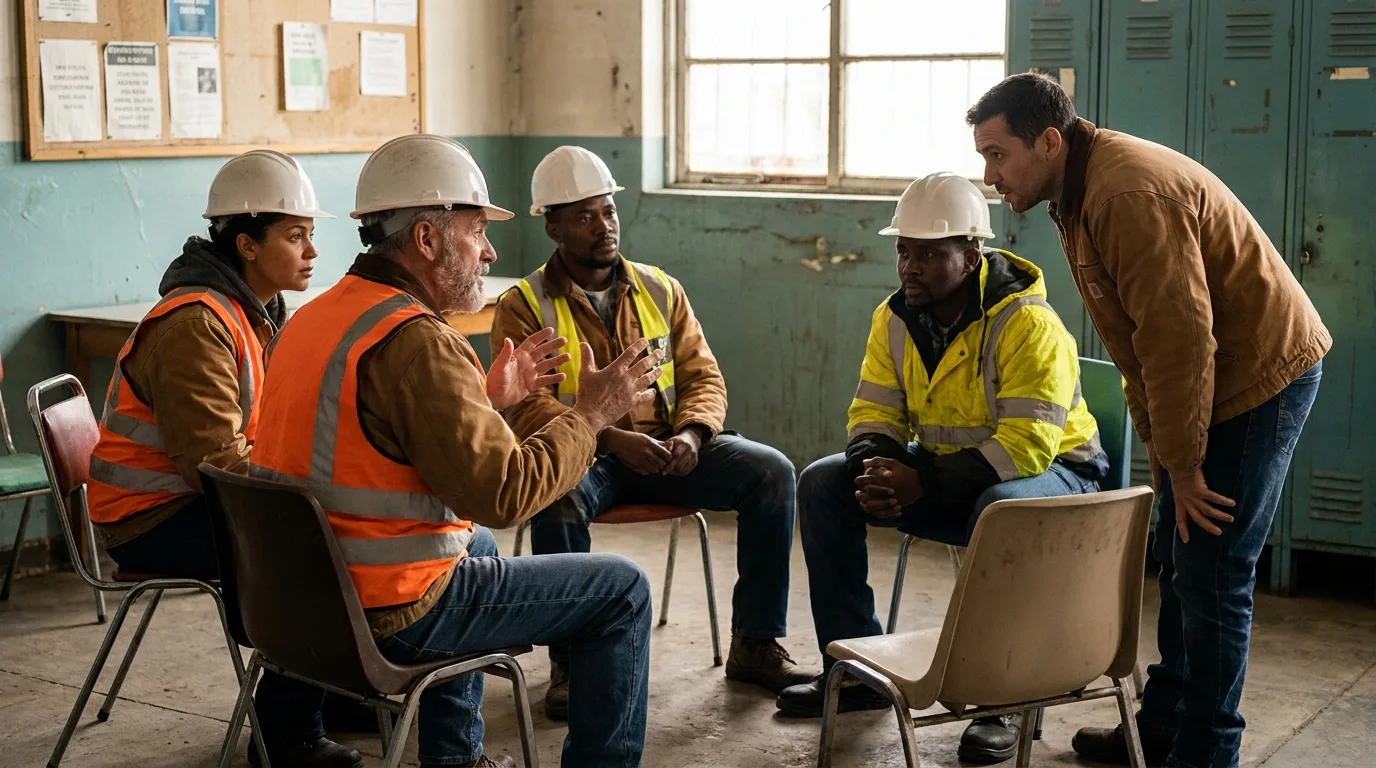
A Sharing Circle: energy-sector workers seated together in a workplace, one narrating while colleagues and a facilitator listen

NECx

Narrative Evidence Collection

Sharing Circles and biographic interviews · WP3, WP7

  1. NECx is the IRES protocol, based on the NCMx Sharing Circle method developed and tested at Green Forum Sweden and formalised for this project in D2.2. Circles meet in venues participants already use, seated in a circle without tables: one voice at a time with a talking object, an explicit right to pass, and hospitality and shared food as part of the design. Sessions may run up to four hours if the group chooses. Where a Circle proves inappropriate, an adapted focus group running the same guide is substituted and recorded as an analytic variable.
  2. Each of the 18 meso sites hosts one four-day site-week: three Circles on successive days (5–8 participants each), followed by ~75–90-minute biographic-narrative interviews in the participant's language: 54 Circles (about 350 participants) and ~130–145 interviews, about 490 contributions and 360 hours of recordings in seven languages.
  3. Every guide separates Strand I (individual narratives: what was acquired, unlearned, relearned, and what it felt like) from Strand C (collective narratives: how the site, the trade or the community accounts for the same transition). Guides also carry appreciative prompts, vignettes for stigma-laden material and place-based mapping.
  4. Each Circle is co-facilitated by two paid community insiders, recruited locally, who recruit their own participants and moderate in the source language. Across the three Circles of a site-week the researcher progressively withdraws (table below), with two audio recorders throughout. Researchers have no access to material before full local moderation is complete.
  5. Coding uses a three-register frame (competence events; affective register; transferability claims) fixed at the M6 calibration workshop and applied in the source language. At least 15% is double-coded per register and language pair; registers whose Krippendorff's α interval falls below 0.800 are re-calibrated and recoded before analysis, 0.667 bounding tentative interpretation only.
  6. Coded segments are tagged to ESCO through ESCOX, accepted only above F1 ≥ 0.70 and routed otherwise to a human-in-the-loop fallback. The tagging serves comparability, not falsification: the OCTAB frame and the segments the extractor cannot place carry the test of the frameworks.

Three Circle conditions: the researcher withdraws

Each site-week runs three Circles of 5–8 participants on successive days, all recorded on two audio recorders (one fixed, one itinerant with the talking object). Each country contributes three observations per condition across its three site-weeks: 18 Circles per condition across the project. Condition III is the only one in which the peer register holds the room.

I · ReM-ICO

Circle 1

Researcher moderation + insider co-moderation

II · IM-ReCO

Circle 2

Insider moderation + researcher co-moderation

III · IM+PCI

Circle 3

Insider moderation, no researcher present + post-Circle individual interviews (PCI)

The lived layer, quantified

The same competences, counted

04

Lived, quantified · The same competences, counted

Two surveys — MCS and TCS

Instrument
MCS: ~1,800 respondents after Round 1; TCS: ~700 in the last round, policy-fed; ETLS/EWCS/O*NET-interoperable
Produced in
WP6 Tasks 6.1, 6.3; WP8 Task 8.5
Deliverables
D6.3, D6.4, D8.4, D8.9
Used next by
Gap computation (Task 8.4); Matrix (Task 8.6); GRBC (Task 5.3)
Answers
RQ2, RQ3

Two instruments, not two waves. The Meso Competence Survey (MCS) follows Round 1; the Transition Choices Survey (TCS) follows the policy return. The second asks a different question and is reported as its own object. The MCS is answered by ~1,800 respondents (~300 per country across six countries); the TCS is sampled at ~700 in the last round from the same sites. Respondents are workers in the energy ecosystem and young people, recruited through the case sites.

Cedefop's European Training and Learning Survey battery is adopted verbatim, so results can be benchmarked against published European values. Alongside the framework-derived items sits a field layer: the competences Round 1 found that the European classification does not name. Each respondent receives a Competence Visibility Report showing which of their competences the classification can and cannot name.

MCS v1 is deposited at month 27 and in final form at month 46; the TCS at month 40 — FAIR, via CESSDA and EOSC (KER3).

MCS

Meso Competence Survey

The quantitative spine · WP6

  1. Two instruments: the Meso Competence Survey after Round 1, answered by ~1,800 respondents (~300 per country across six countries), and the Transition Choices Survey after the policy return, sampled at ~700 in the last round from the same sites. Respondents are workers in the energy ecosystem and young people, recruited through the case sites with panel top-up.
  2. Four prescribed blocks: GreenComp- and DigComp-derived constructs (the frameworks under test); EWCS-comparable working-conditions items; validated O*NET scales; and a canon-replication module mirroring the founding green-jobs study.
  3. Interleaved with them sits the field layer: the competences Round 1 found that the classification does not name, delivered as the Competence Visibility Module (D6.4). The ETLS learning-participation battery is adopted verbatim, so results are reported as benchmarked deltas.
  4. Deposits: MCS v1 at M27, final at M46; Transition Choices Survey at M40.

Declared bias: design parameters, not contaminants

Greenpulse’s field epistemology, based on the IRES NCMx Sharing Circle method developed and tested at Green Forum Sweden and formalised for this project in D2.2, inverts the standard reflex: several classic biases are treated as design parameters instead of contaminants, declared, varied and reported rather than pretended away.

Researcher-presence (ethnographic) effect

measured

The three Circle conditions run at the same site, with the same insiders and the same guide, and differ only in who enters the room, so the researcher-presence effect on narrative depth and variety is measured directly: 18 Circles per condition across the project (task 3.3; D4.1 for Round 1, consolidated in D7.1).

Similarity & selection bias

deliberate

Insider recruitment narrows local variance so that personal and affective enunciation becomes possible; comparison is then made across sites and regimes rather than within a synthetic national middle.

Language bias

insider moderation

Circles are moderated in the source language by local insiders, and coding is applied in the source language by the national coders present in the field.

Hawthorne & recording effects

addressed and reported

Recording is necessary. An acclimatisation period, two audio recorders (one fixed, one itinerant, passed with the talking object), the insider-moderation condition, and reflexive memos and debriefs after every session address it, and all of these are reported.

Availability heuristic

displaced

Researchers have no access to material before full local moderation is complete, which displaces the availability heuristic from the analyst to the field. Three Circles on successive days limit political, seasonal and sectoral volatility.

Participant safety

governs throughout

SOGIESC-related and status-related content is elicited only in individual settings, never in Circles, under the consent architecture of task 1.2, and is reported in aggregate only.

Data, ethics and AI use

  • Raw audio and video are working material, not deposited data: recorded only under explicit oral and written consent, held by the collecting beneficiary and destroyed at the retention horizon fixed in the Data Management Plan. What is deposited is the derived layer, with direct and indirect identifiers removed.
  • A Data Protection Impact Assessment is completed before any collection begins, and research-ethics clearance is a hard gate on fieldwork. The COREQ checklist governs reporting of the qualitative strand.
  • Declared AI uses are ESCOX/LLM-assisted taxonomy extraction and machine-translation support in coding. Inference is self-hosted, so no personal data reaches a third-party model provider, and every AI-derived coding that enters analysis is human-verified.
  • IRES runs an open-weight European model locally as an assistant that proposes where a narrative segment bundles green and digital competences, for human coders to confirm or reject (TRL 2 to TRL 3). Its readings are returned to participants, labelled as machine-generated, so that people can contest how the machine read their accounts.

Next door

Energy